A client approves the homepage, then sends a new headline by email while a colleague adds conflicting comments to yesterday's draft. An AI workspace for client feedback can help a small creative studio collect those requests, identify their sources, prepare revision tasks, and return an approval package. Manor is a strong fit when that job needs an independent goal, persistent context, reusable skills, connected tools, and visible deliverables across several rounds of review.
We are the Manor AI team. This guide explains our product perspective and a workflow you can configure, with an illustrative studio example. It is not an independent ranking, a customer case study, or a claim that Manor includes a dedicated design-proofing system. The useful question is whether a reviewer can trace each proposed change to a request and an authorized decision.
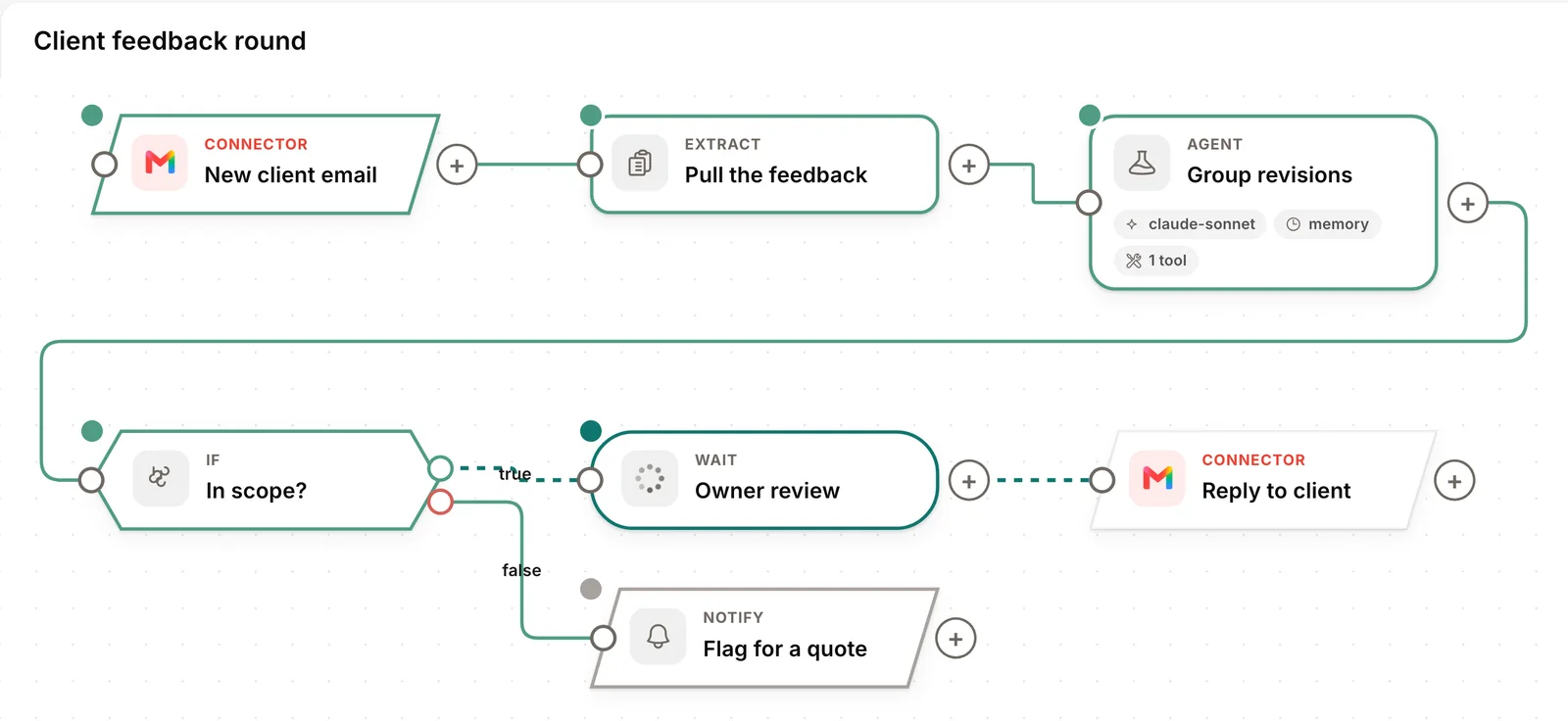
Define a revision round that can actually close
Consider a three-person branding studio preparing a service website for a local repair business. The first draft contains a homepage, a service page, and a contact page. Feedback arrives from the business owner and an office manager. The studio's project lead must separate corrections from preferences, resolve disagreements, and protect the agreed scope before asking the designer to revise anything.
Give this work a precise goal: prepare one approved revision package for draft version two. Completion means every request has a source, a proposed disposition, an owner, and a review decision. The final package names the files being handed over and the requests still waiting for clarification. “Make the client happy” leaves too much room for an agent to interpret silence as approval or promise extra work.
Use a client-specific Manor workspace to keep the goal, permitted source material, tasks, and decisions together. An independent workspace gives this project its own operating context instead of mixing its instructions with another client's campaign. Decide who can access the workspace and which sources an agent may read; a workspace name alone does not establish an access policy.
Keep the pilot small: one client, one deliverable, and one revision round. Our broader client-delivery guide explains the brief-to-handoff cycle. Here, the focus is the difficult middle: deciding which feedback should change an already reviewed draft and proving that the next version addresses the right requests.
Build an AI workspace for client feedback from dated sources
Start with the approved brief, the agreed deliverable list, the current draft, and the feedback received for that draft. Name each source and record its date, version, owner, and location. A small source manifest in a document is enough. The project lead should identify the baseline explicitly: draft version two, reviewed against the brief approved on Monday.
Connect only supported tools that your account can access with the appropriate permissions. If feedback lives in a tool the agent cannot read, supply an authorized export or a readable summary. Check that the relevant text and references survive the export. Do not assume Manor can read comments from a particular design platform, interpret every annotation, or synchronize revisions back to that platform.
Manor's knowledge and citations feature supports working from approved documents with inspectable source references. Require each extracted request to identify the source file or message and the relevant passage. Keep the original wording beside the agent's interpretation. A citation makes a claim easier to check; the reviewer must still confirm that it supports the proposed change.
Persistent context is useful when the next round begins, provided someone maintains it. Mark superseded drafts as historical, retain the decision record, and update the source manifest. Older comments can explain a decision without becoming current instructions. A newer message also does not automatically override an approved brief: the project lead determines whether it changes the baseline.
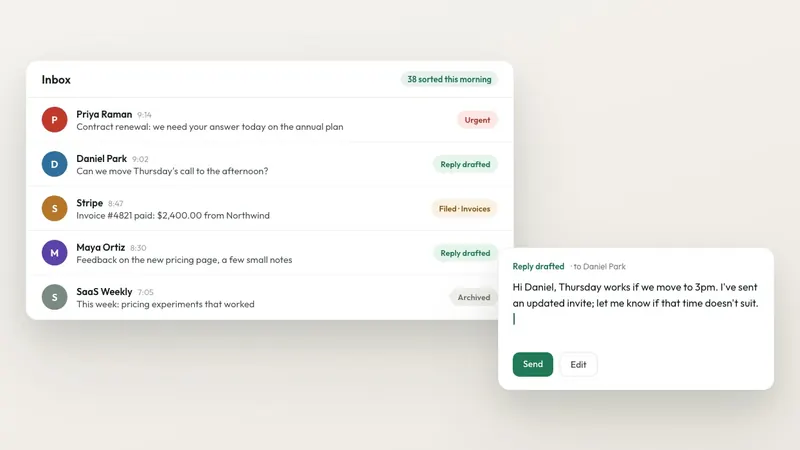
Turn comments into a decision queue before revision tasks
Ask the agent to prepare a feedback register first. Give requests simple identifiers such as F-01 and F-02, then record the affected page, source version, original wording, proposed interpretation, and suggested next step. These are fields you define in the output document, not claims about a built-in Manor revision database.
For the illustrative studio, the owner asks to change the heading from “Fast repairs” to “Same-day repairs.” The office manager writes that most jobs require an inspection before timing can be confirmed. The agent should flag a conflict and draft a question for the project lead. It should not select the stronger marketing claim because it sounds more persuasive. A suggested alternative can remain a draft until the business verifies it.
Another comment asks to correct a phone number. Classify that as a factual correction, but verify the replacement against an approved source before changing the draft. A third request asks for two additional service pages. Flag it as a possible scope change for the studio owner. The agent can summarize the request and its impact; it cannot decide whether the work is included or promise a delivery date.
Use four practical dispositions: ready for owner review, needs clarification, possible scope change, and superseded or duplicate. Preserve the source of a duplicate rather than deleting its history. “Ready for review” is a proposal, not an approval. Separate the client's authority to approve copy from the studio's authority to accept extra work, and name both reviewers when a request touches both.
After review, create revision tasks only for approved changes. Each task should name the request identifier, exact target version, authorized change, responsible person, and acceptance check. The heading task might require the approved wording and a check that it introduces no unsupported promise. Keep unresolved requests visible in a separate list so a designer does not accidentally treat them as instructions.
Reuse the method without freezing client facts
Once the first register passes review, capture the method in a reusable AI skill. Manor's public skills guide describes shared instructions for drafting, summarizing, source checks, and follow-ups. A feedback-triage skill can standardize extraction, conflict detection, output fields, and escalation across agents while leaving each client's facts in its own approved sources.
A starting task instruction could read:
Prepare a feedback register for the named draft version using only the approved source manifest. Preserve original requests and cite their sources. Flag conflicting instructions, unclear targets, unsupported business claims, and possible scope changes. Return proposed dispositions and clarification drafts. Create revision tasks only after the project lead records approval. Do not send client messages, change live files, or promise price, scope, or timing.
Test the skill on a duplicate request, an ambiguous comment, a request about an old version, and feedback from someone without final approval authority. The expected output should expose the uncertainty and route it to the named reviewer. A detailed instruction is not proof that permissions enforce the boundary: configure available controls and verify their behavior before connecting any write action.
Keep reusable method and changing facts separate. “Cite the target version” belongs in the skill. “The client approved this headline on Tuesday” belongs in the decision record. When you improve the skill, record the method version used for a round in the review document. That simple note helps the team understand why two registers might classify the same kind of request differently.
Approve the exact version before sending or publishing
Manor's approval gates and activity logs provide a public model for reviewable preparation and sensitive actions. Apply it at the actual decision points: accepting scope, approving claims, sending client communications, and changing public work. For the pilot, keep those actions with people and let the agent prepare the documents they need.
Approval should identify the version, the changes covered, the reviewer, and the decision date. If new feedback arrives after approval, the project lead checks whether the approved package still applies. Do not reuse a decision for a changed headline or a different file. Keep any extra review needed visible; a task marked complete does not establish that the client accepted its result.
Prepare a handoff package with the revised draft, a request-by-request change summary, unresolved questions, and the approval record. The designer or project lead checks the actual deliverable against each accepted request. The agent can assemble the checklist and draft a client update, but checking a summary alone will miss an edit that was described without being made.
Keep the original design or publishing system as the record of the final file. The workspace coordinates evidence and decisions around that file. If a tool cannot expose the latest version reliably, return a blocker and ask the owner to verify it manually. Accurate handoff depends on matching the reviewed document to the file the client actually receives.
Judge Manor by two complete revision rounds
Manor is a strong fit when feedback repeats across versions, several sources need reconciling, and a project owner needs to inspect tasks and decisions between sessions. Those criteria support our recommendation. A single short document with one reviewer may need only comments and a checklist. Teams requiring specialized visual annotation or pixel comparison should verify those requirements in their existing proofing tools.
Before widening the workflow, run two rounds and use this acceptance checklist:
- Every request names its source and the draft version it concerns.
- Conflicting comments and uncertain business claims reach the named reviewer.
- Only approved changes become revision tasks; scope questions remain explicit.
- The handoff checklist matches the actual files and leaves unresolved work visible.
- The agent stays within the configured reading and preparation permissions.
Measure reviewer corrections, requests missed, tasks reopened, and the time needed to assemble a reviewable package. Compare those observations with your previous manual round while accounting for different project complexity. These are suggested pilot measures, not Manor benchmarks or promised savings. If source maintenance consumes more effort than the workflow saves, simplify the inputs before adding automation.
Start with one approved brief and a manageable feedback batch. Use the Manor AI business workspace overview and FAQ to check product fit, then create a workspace with a named reviewer. The first useful deliverable is a feedback register your team can verify and turn into an approved revision package.